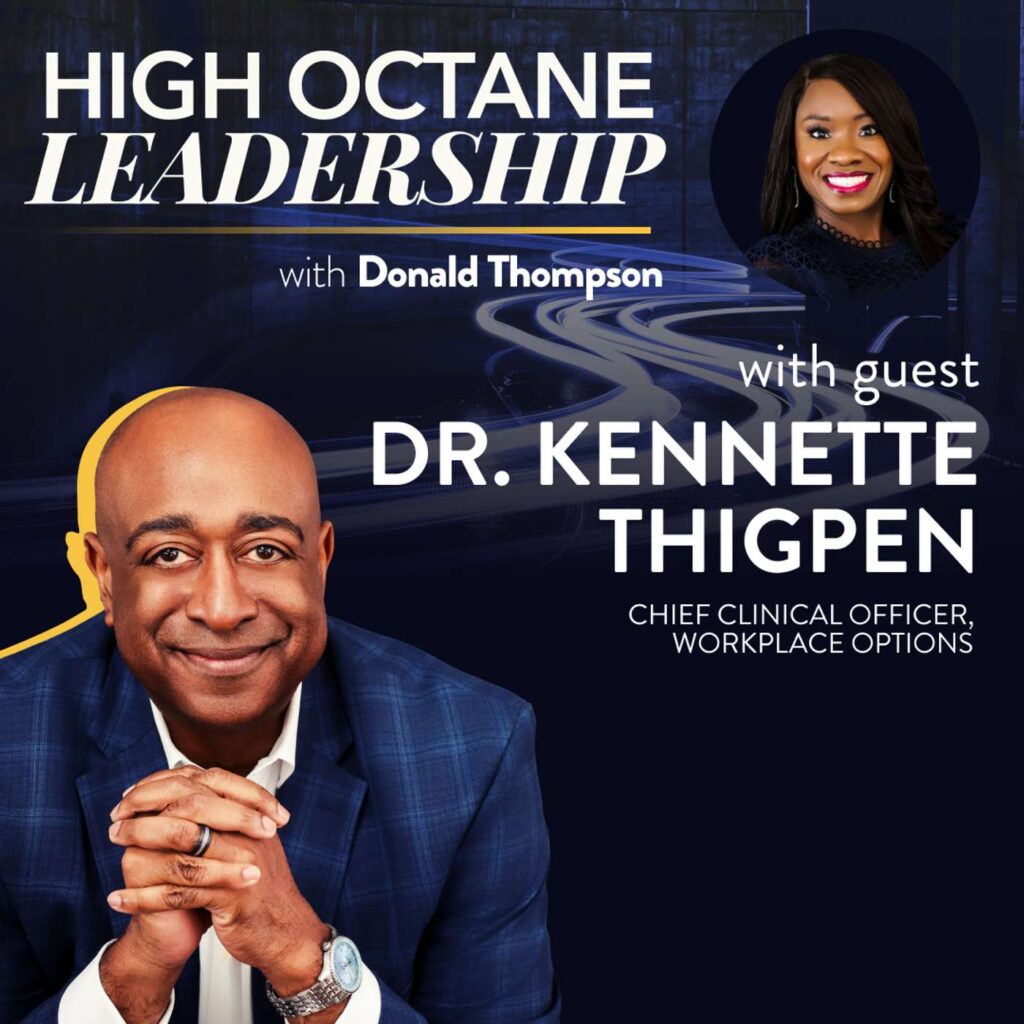
Attention to mental health is not a workplace benefit. It is the factor that makes or breaks your workplace. In this episode of High Octane Leadership, Donald Thompson sits down with Dr. Kennette Thigpen, Chief Clinical Officer at Workplace Options, to explore why embedding psychological safety is mission critical to your success as a leader and organization.
What You’ll Learn:
- How to truly infuse mental health into your organizational culture, policies and daily practices in the context of employee engagement and retention
- The Psychosocial Risk Framework your new risk assessment tool to identify systemlevel stressors that create presenteeism, absenteeism and turnover
- Why psychological safety is your secret weapon for high performance teams
Transcript
Speaker 0: Promote a culture of inclusion, supercharge your communication, and unleash the full potential of your teams and leaders with the inclusive handbook collection from the diversity movement. As part of the collection, I wrote the inclusive leadership handbook with Kurt Mitterweather to empower leaders with tools needed to cultivate a culture that fosters creativity, innovation, and employee engagement. Through strategies, exercises, and self reflection, leaders at all levels can enhance their effectiveness. Learn more at the diversitymovement.com backslash store. Use code HOL at checkout for 25% of your first order.
Speaker 1: Welcome to High Octane Leadership with Donald Thompson. This season, we’re diving deeper with more solo episodes where I’ll share the experiences that have led to recognition by Forbes, Fast Company, and others. Not as a boast, but as milestones on my entrepreneurial path. From growing multimillion dollar firms to successful business exits and building high performance teams with a global perspective. I’ll reveal the insights and strategies from my journey and share them with you so that we can win together. Alongside these solo episodes, we’ll have industry visionaries and thought leaders, and we’ll explore effective leadership. Ready to empower your leadership journey with real success stories? Let’s embark on this transformational journey together. Welcome to another episode of High Octane Leadership. I am your host, Donald Thompson. Today, I’m joined by Doctor. Kenneth Thigpen Harris, trusted and sought after professional who utilizes her skill to help multimillion dollar companies create an atmosphere that promotes mental well-being in the workplace. Doctor Kanette, also known as Doctor K, is that okay? Yeah, that I share with you, is the chief clinical officer at Workplace Options. She is a dynamic force both in the corporate mental health and well-being space and as a business leader. Renowned for her expertise and empowering presence, she inspires engagement in every space she enters, and she shared meaningful insights in her book, Cut Yourself Some Slack, 52 tips to boost your mental health for a happier, healthier, and more hopeful you. Doctor. K, welcome.
Speaker 2: Oh, it’s an absolute pleasure, Don.
Speaker 1: I wanna jump in, but I wanna start with a little bit about your journey. I’m always interested in how people chose their career path, their profession. If you’d like to share with the audience what brought you into the mental health and the well-being space, and then what motivated you to now be a champion in that space? So want to get into it, but you have excelled.
Speaker 2: Awesome. Really great question. I don’t know if you I know we’ve had some side conversations. I’m not sure if you know this about me. When I actually started out being wanting to be a nurse. And not just any nurse, a flight nurse. There was something about me that I wanted to be able to help people in their worst moment and to be able to stabilize and heal them. However, as I was at university, we had so many credits. We were able to go into different rotations at, you know, hospitals in different places. And I quickly learned that I pass out at the sight of blood. So Limiting. Yes. I’m like, okay. I’m not really sure how I’m gonna do this flight nurse or nurse thing at all. So what are you gonna do? So I went and spoke with my adviser, and she said, you know what, Kenneth? Let’s find something that you’re still passionate about, which is helping people, but let’s do it in a way that aligns with who you are. When she said in a way that aligns with who you are, it just really spoke to me. And so she said, have you ever thought about this social work thing? And I was like, I don’t know. And she’s like, well, let me tell you all of the things that you could do with it. And of course, one of those paths was going into mental health. So I was like, you know what? This is still a really great way for me to help people to sit beside people and help them at their worst when other people don’t get to see what they’re going through. And so that’s how I started on the mental health side of things. Now I know psychological safety is another factor of piece that you’re like, okay. How did you get there too? Now for me, that was my first two careers at work. I had the most horrible bosses. Now don’t try to go on LinkedIn to figure out what my first two jobs were because they’re not even on there. Okay. But I had the most horrible bosses where I really felt like they stunted my growth. They wanted me to shrink down. They had me second guessing myself. And the crazy part is I walked in one day, I just quit on the spot. Now I do not advise that for people, but I was like, you know what? It was that bad where I said, I’m quitting on the spot. But I also knew that I was an adult and I probably needed a J O B, a job. And so that very same day, I went out to different mental health companies, and I found this one lady at a mental health company. And we talked for a while, and it was amazing. And she said, I’m the executive director. She said, however, my director will be back shortly, and she will interview you. So within, like, two hours I had to interview. They hired me on the spot. The executive director came back to me and she said, you know what? She said, there’s something about you. This was my one of my first jobs at a, college. She said, you are gonna be in leadership within six months, and she said, and it will never go the other way. Within three months I was in leadership and I have been in leadership ever since then. And I think what she did for me was create a space for me to be who I was, to show up authentically and to let me strive and grow and ask those hard questions. And at that moment, I knew there was a clear distinction and difference between those first two bosses and that one I was going to interview with, and that was safety. And at that moment, I knew that would be my calling.
Speaker 1: That is fantastic. And I love that story. And the thing that I would extend from my experience with great leaders that have helped me is that high expectation. One of the biggest gifts you can give someone is projecting what they can be and then communicating that you’re willing to help them get there. And that is such a motivator and a trust builder in building people along with building the bottom line of your organization. I really appreciate that. One of the things that I’m super interested in as we think about kind of your day to day at Workplace Options, talk a little bit about the company, your role within the business, and how we’re making an impact on lives globally.
Speaker 2: So at Workplace Options, I’m the chief clinical officer, and my role is to oversee all things clinical. And that goes from clinical excellence to clinical quality and how our clinical services are delivered to our members. Big role because, of course, it’s it’s a global one, and so you want to ensure that you are looking at best practices. You’re looking at evidence based practices. You’re looking at standards and regulations that are different across the globe as well. I think one of the things that’s really driving forces probably a couple of things. I think one is equity, and equity in that we want to be able to provide access to individuals no matter where they are. When you start looking at things across the globe, you have a shortage of providers, mental health providers. You have wait times that are astronomical beyond belief. And so how do we provide support to people where they’re able to access their service very easily? And one thing I love about this equity piece, Dawn, is that, of course, we have our clients that, of course, their employees get services from us, but we believe in this so much so that we have our Care Connect cards or the We Care cards. And so if I’m just out and about at the mall and I have that conversation with someone and I know they’re in a tough place and they’re they’re struggling, I can give them that card and they can call in. So when we talk about access, that’s one piece that’s super, super huge. I think another piece is just dignity for people. Again, real lives, real people going through real challenges. And we want people to be able to come in and speak without the fear of judgment and know that those things are confidential. Like I can call in and speak and they’re gonna be confidential. I would say the last piece is really about compassion, courageous compassion, where we allow those people, those that work for us, but the ones that are calling in and myself to be able to show up and share and to make recommendations of, like, this isn’t working. This is working, and to move forward accordingly.
Speaker 1: That is really powerful. One of the things I was impressed with as my firm was acquired by Workplace Options, and now we’re fully integrated and a part of the team, was that people can call in to their EAP programs, their employee assistance programs, and they’re gonna be helped in the language of what they live and speak and work every day. And so that global footprint leads me to my next question. What are some of the common threads? We always talk about the differences between The US and Europe and Asia and all the different things. What are some of the common threads that you see in terms of the support people need to be effective at work?
Speaker 2: More more so the people at work, or would you say the the people that are calling in?
Speaker 1: The people that are calling in. When it
Speaker 2: comes to the people that are calling in, I think they need quick access. So they want to be able to call in, get the support, but they also wanna get the support in their local language. So not only their local language, but also that’s culturally appropriate to them. But I think that cultural appropriate piece is super important because a lot of times when people call in I use the word crisis a a little lightly here not to minimize it, But when people call in, they finally get to their breaking point, whatever it is for that individual. And they want to be able to talk in their local language in a way that’s culturally appropriate for them because that’s typically what they revert back to when they’re in a a challenging time.
Speaker 1: There’s a lot of terms around mental health, and there’s a lot of different points of view. How do you help business leaders destigmatize mental health such that it is something that we’re all working on and working with to find solutions together versus years ago? Right? I never really would have talked about well-being or needing a mental health day. How do we help leaders create the structures, right, to improve those environments that can be something that people more openly seek assistance and support?
Speaker 2: Great question. So I think it’s really about how do you embed versus append mental health programs. So how do you embed versus append? When you append, and that’s typically what we see, is it’s kind of an afterthought. It’s like, you know what? World Mental Health Day is coming up. Let’s do something for that day. We say suicide prevention month is coming up. Let’s do something for that. And then that’s it. So we checked a box or we’d kind of say, oh, let’s just do something to see what the utilization will be. And that’s it, but there’s way more to it. But when you embed it, it’s infused into the culture where it becomes a part of everything that your organization does. It’s infused into the DNA of that company. And so what that begins to look like is if you take a look at your policies, your procedures, and your practices, do they align so that your employees can be mentally well? Part of this is about what are those psychosocial risk factors that are within an organization that are creating stress and strain for your employees? If you know that as an organization or a leader, then you are going to put mitigating factors into place because you don’t wanna risk. We often think about the financial risk of the companies, natural disaster risk for companies, but we don’t talk about the mental health ones.
Speaker 1: So now I wanna unpack this a little bit. Psychosocial risk is a term that is more globally used Correct. Than in The US. That’s correct. So break down a little bit for our audience some impacts to psychosocial risk that can really weave in that understanding of that that term?
Speaker 2: So psychosocial risk factors, again, anything when I talk about anything, I’m saying anything that causes stress or strain for your employee. That could be from their work environment to their work schedule, to how they do their work, to all those different things. And when you have those psychosocial risk factors, what begins to happen is you have presenteeism, ching, we’re talking money. You’re talking about absenteeism, ching, we’re talking about more money. We’re talking about turnover. Could I keep the cha chings going? So it’s more money, more money that your company is losing because you don’t have an engaged and I know you love talking about engagement. You don’t have an engaged employee because of those psychosocial risk factors that have been created within a work environment.
Speaker 1: So would you say and I’m gonna make a statement and see if you agree and expand on it. So psychosocial risk are those system factors, and then psychological safety is the people interaction factors. Yeah. Would that be a good way to explain it? Because one of the things that I find is that as business leaders, we have so many things that are coming at us in terms of how to create culture that we often don’t know where to start and where to focus. And so if you were advising a leadership team to look at their psychosocial risk factors, how would they even start doing that? If they believed everything they’re hearing, they’re like, yeah, give me some of that. I need to talk to doctor Kate. Where would they start?
Speaker 2: It starts with a conversation. It starts with listening, and that can happen in several different forms and ways. So whether that’s a one on one conversation with an employee, with a leader, whether that’s in a a larger group setting, whether it’s by surveys, pulse checks, you name it. Talking to the people and listening to what they have to say. Because trust me, they have a lot to say, and they will start to break down of even something as simple as PTO time, a mental health day, how I have to do my work, when I have to do my work. All of those things are factors. So if you can start by listening, and you may end up with a list of a 120 different psychosocial risk factors, you may be thinking, what the French toast can at? Like, what am I gonna do with that? But I think this reality, when you think about a regular risk mitigation plan, you probably end up with several different factors and you start ranking those risks. And then you start looking at what’s the impact that this one is going to have on my organization and my people. And then once you understand that, there may be some at the very bottom where you’re like, you know what? Yeah. That is a risk, but the impact’s not that big. So it’s okay for now. But there’s others that are gonna be starkly glaring. We’re gonna say, we need to do something now.
Speaker 1: One of the things that I’m seeing is there’s a lot of and back to the risk, and let’s see if we agree here. There’s a lot more instability in the workplace today. Right? So when you think about things that are corely wrong, sexual harassment, but we don’t really think about things in terms of how harsh words impact someone’s well-being, how they’re spoken to. Even if the tenor and the tone are not taking consideration because the boss or the leader is thinking, what I’m saying is right, what I’m saying is true. I’m just trying to be honest. How do you think about the behavioral changes that people need to make so that we can reduce those negative impacts that we may cause often unintentionally?
Speaker 2: Yes. And I think part of that is about training. It doesn’t not the answer to everything, but training is super important to understand certain small nuances like you’re saying. And I think a big nuance that people tend to overlook is the why question. And so maybe you’re talking to an employee about a project that they’re working on, and you say, well, why did you do that? It has a very negative connotation to it as almost blaming as, like, what you did wrong. But how would that same employee take it if you say, this is what I did, and you say, tell me more about that. Now I feel like, oh, I’m I’m empowered to share more about the decision that I made versus the why that makes me start to shrink and think, uh-oh, did I do something wrong? And so when you start to train people, you’re able to start showing them the different signs to be able to recognize and respond and what to do. Because to be honest, a lot of leaders, when you start having those conversations, they get nervous sometimes. Like, okay. So if we’re gonna have this conversation, I’m getting a little bit nervous, so I won’t even touch it. And that’s the worst thing you can do is to ignore it because, honey, it’s not going away.
Speaker 1: What are some of the things that you would think, talk about, seem in terms of people putting mental health and well-being as a part of their corporate strategy, as a part of their business strategy?
Speaker 2: If you’re not doing it, you’re in trouble, first of all. And I think a lot of times what we begin to hear is, oh, well, doctor k, like, we don’t appear like we’re a soft organization. Or, oh, doctor k, we’re going to it’s too expensive. Or, oh, we don’t have time for it. Let me tell you what is expensive, a company full of employees that have mental health challenges, because it goes back to exactly what we talked about. You have individuals who are not engaged, the present team, the absenteeism, the productivity, the innovation and creativity for people that you begin to lose. And so the cost of that alone is way more expensive. You can’t afford not to put some type of program into place. No.
Speaker 1: I think that’s powerful. I wanna pivot a little bit. I wanna talk about the book from it. One, just in the title. Right? The 52. So it feels like I can do something a week at a time. Talk to me about the genesis of the idea and the concept and share what a reader gets from spending time with you in in that literary form.
Speaker 2: So the book 52 cut yourself some slack, the 52 tips. It actually started out of COVID. K. So during the COVID time, you guys I don’t know if we wanna go back there and reminisce, but I just remember being back in the house and realizing how I was feeling of being kinda stuck in the house, but also talking to other people about the challenges that they were having about being in this new environment for a while. And so I said, how can I help people? And so you may not know I’m not doing direct practice now in regards to therapy with individuals. But during that COVID time, I said, you know what? I’m home. There’s people that need my help. And so I’m going back into the business. And so during that time, during COVID, I actually went back to doing direct practice one on one work telephonically or virtually. But then I was like, okay, I’m only impacting a certain amount of people.
Speaker 1: That’s right. It’s only so many hours.
Speaker 2: So many hours in a day. So I set up my full time job. And so I said, how else can I support people? And I said, you know what, what if I give people a tip each week and posted on LinkedIn, Facebook, and Instagram. And that’s what I began to do. And so I’ve been doing that for about five years now, every week posting a tip on Wednesday where people can have a piece of doctor k, but also a tip in the moment that can help support them through that week.
Speaker 1: Five years worth of these tips.
Speaker 2: Five years
Speaker 1: worth of these tips. I would have a different little talk
Speaker 2: after this. But that’s
Speaker 1: great. Good. Good. And so Got my brain loose. But go ahead.
Speaker 2: Going. I know it’s going. And so at that point, I was like, what if I were to put this all into a book and a workbook? So it’s actually a book and a workbook where people can then say, you know what? You don’t have to do it in order, but you could flip through it and say, you know what? Fear is what has me today. Let me find this tip on fear and let me work through this activity. And so it actually provides some information about what fear really is, but then it gives you the practical strategies. I’m big on having something practical and tangible to do and apply that’s gonna really help you. It’s one thing to read it, but it’s something else to do it. And so then there’s practical strategies or an activity for you to do that’s going to help you. So it started actually through COVID with a weekly video tip that I posted on social media, and then I turned it into a book so that people could have the whole book with him.
Speaker 1: That is fantastic. And we work together at at Workplace Options. And one of the things that I’ve found that I think people sleep on, quite frankly, is that when business executives are highly active on LinkedIn and social media with authentic content, not just active and throwing out a a fulfilling quote of the day, but authentic content, right, it not only builds your personal brand, but it creates a halo effect back to the company. Because people wanna do business with people that they know, that they trust, that they’re familiar with, and you can create that connectivity, right, through the use of social media. And so that’s why I lit up when you were talking about the consistency that you were building on that. And so I really applaud that. And I can see the business benefit that connects between both worlds. One of the things that when you write a book, there’s obviously 52 elements and all of the different things. Give me, like, the two minute elevator pitch in the book, because I wanna capture this for a couple of different reasons. Number one, I want people to get it. But number two, and I’ll make the point after that, most people live in sound bites. Right? And so take a minute and just give me the two to three minute of why somebody should read your book.
Speaker 2: The 52 tips, it is in a sound bite typed manner where people are able to consume it very quickly and to take action on it immediately. That’s what’s really important about the book. Again, 52 tips people would always say, like, why did you do 52? Because it’s not that you don’t do it every day of the year. If you just pick one and do it commit to one each week of the year, read it quickly, and implement it immediately. You’re gonna see a world of difference in your mental health and well-being.
Speaker 1: So let me share this with you, and that was perfect. You you think because what you talked about, and you can even tell them about inflection, is microlearning. People are so busy. They’re so inundated with all kinds of different information, challenges, good things, scary things, all this stuff. If you can give people four to five minutes of learning and then something that they can do and deliver value for themselves, for their organization tomorrow, they’re gonna try it. And that, to me, in terms of learning new things and applying new things, is super important. We can talk about psychosocial risk. We can talk about psychological safety, all of these big topics. But what we really wanna do is get leaders to say, if someone in your Zoom call of 15 folks hasn’t spoken up, please invite them into the conversation. Those are the types of tips that people need so that they can get in motion while they’re learning all of the different things they need to do. There’s some practical things they need to do.
Speaker 2: Yeah. I love that. Growing up, I had a mentor. So the mentor that I met years ago when I was looking for that job when I quit on the spot, the one of the things that she taught me was it’s about learning something, doing something, learning something, doing something. And that has it’s super short. It’s super simple, but it’s super impactful. And so as I go through life, I still clearly carry it with me now of learn something, do something.
Speaker 1: That’s right. And we are you know, another thing that’s evident from just listening to you and and knowing you professionally, we’re all impacted by the environments we work and live in. And one of the things that that I will I’ll I’ll put you on the spot again. This is super easy, and I’ll go first. Is we both report to Alan King at Workplace Options. And Alan obviously was the catalyst in in acquiring the diversity movement in my firm and and integrating this in. And one of the things I’ve gotten to observe over the last two years is how he demonstrates some of the things that we advocate and do, which is very important to me as a professional and why I stick. And so one of the things is Alan is a hard charging leader. He wants business results, like, don’t get that. Yeah. But the way he delivers that is through an empathetic mindset. He’s very open to hearing alternative points of view, and he wants you to own responsibility for the things that you mutually agree on. And those are traits of an inclusive leader, of a thoughtful leader, someone that thinks about mental health. And he pointed to me when we were having a a one on one dialogue about a few things. And he said, Don, ultimately, our goal is to help people. Now we can put all kinds of things around that, but when I wake up every day, that’s ultimately what we wanna do. Would you share a couple things you’ve learned from working with Alan that you’ve observed that really live the brand is the way I would like to script?
Speaker 2: I would say it’s the human centered approach. Every day he comes to work, it’s that human centered approach of how he interacts with each and every one of us, and I can speak for myself in particular Mhmm. But how he interacts. But the follow through on that, sir, I remember there was one weekend in particular where that Friday night and that Saturday night, we were getting these high escalation calls. And Alan said, hey, Kenneth. We have a situation I need to take a look at. Great. I did it. And it was a holiday weekend on top of I think it was Easter weekend. He called me again and he was like, Hey, it’s me again. I’m so sorry. For the third time, he was like, I know you think I’m playing jokes with you, but I have one more. But at the end of all of that, we thrive in crisis. And he said, thank you for showing up. It was just a simple, thank you. And just him saying thank you was enough for me. But then that Monday, when I came home from work, there were flowers at my house And I’m thinking who in the heck sent me flowers? And I opened it up and they were from Allen, but it shows you the appreciation, but the human centered approach that definitely cascades down to the business, because even in the EAP industry, I love to say it’s the human element that’s supported by tech. So we’re powered by people supported by tech, and we can go in a completely direction now.
Speaker 1: It would. We got plenty of tape. But
Speaker 2: but, you know, it just speaks to even in this evolving world of technology and where the industry and the world is going, the human touch is still so important. You cannot you cannot replace that. And so the fact that he takes the time to see me as a human means more to me than anything. And one thing I definitely picked up from Alan.
Speaker 1: Right. So now let me share with you all something, and I’m bringing this all together, and this was purposeful. I want you to think about the background that doctor Kaye has. I want you to think about the accomplishments that she’s done. And as a business leader, she is still more locked into the organization because someone cares. Someone cares. I, as a hard charging leader and entrepreneur and all the different things I do and can do, am locking into an organization because I’m working for somebody that I know cares. And anytime you’re working at a high level of business, you’re gonna have some good things you gotta discuss, and you’re gonna have some moments you’re working together. Yeah. Right? But those things can all be done in a first class manner, in a people first manner that then allows me and doctor Kaye, when we are representing WPO, it is authentic what we’re talking about. It’s authentic when we believe that employee engagement starts from the top and then trickles down, and then we have an opportunity to work for an organization that lives that as the brand. And so that’s why I asked the question in dealing that way. As we land the plane for our conversation, today, one, I want you to have space of anything I didn’t think to ask. So I’m gonna give you space to do that. But here’s the final question for me. If you had a magic wand and you were talking to a 100, a 2,000 leaders, what would you leave them with in terms of thinking about mental health as a part of their business strategy?
Speaker 2: So nothing else that you missed. I think you did a amazing job covering all aspects and bringing us and landing the plane smoothly. It’s like one of those claps, like, yeah, he landed it smoothly. But if I had to leave one thing with leaders when we talk about mental health is mental health is not a side conversation. It is the strategy. Period. And mic drop.
Speaker 1: I tend to know when to, say thank you. And when someone was awesome, what I will say is someone asked me the other day, they said, Don, with your businesses, with different things, you have a pretty good hit rate for things working. And I said, what is the secret sauce behind that? Because you succeed in a lot of different types of businesses. It’s because I find, get to know, and listen to amazing people. And what it does is inform my learning journey. It informs the way that I think about business and growing as an executive. And I really, really value my network of individuals that are willing to share with me and with others, but also willing to to guide me as I go through my journey as a business leader. And I count doctor Kaye as one of those newest members. I’m very appreciative of our partnership, and we’ve been on stage and and and dinner and different things together. But this was a wonderful conversation, a needed conversation, and thank you for spending time with us.
Speaker 2: Absolute pleasure. This is a powerhouse right here, y’all. If you don’t know, there’s some secret sauce all up in here.
Speaker 1: Oh, I appreciate it very much. Thank you for joining us on High Octane Leadership with Donald Thompson. Today’s episode is a step in our collective journey towards leadership excellence. Remember, every story we share and every insight we gain is a piece in the puzzle of our leadership journey. For more insight and detail, hit the subscribe button so that we can stay connected. For deeper information and more episodes, go to donaldthompson.com. Continue to lead with vision and purpose. And until we meet again, embrace your role as a high octane leader in the ever evolving world of business.
About the Guest(s)
Dr. Kennette Thigpen is the Chief Clinical Officer at Workplace Options, where she oversees clinical excellence, quality and service delivery across a global mental health and employee assistance platform. With a background in clinical social work and mental health counseling, Dr. Thigpen brings deep expertise in workplace mental wellbeing, psychological safety, and organizational culture transformation. She is the author of “Cut Yourself Some Slack: 52 Tips to Boost Your Mental Health for a Happier, Healthier, and More Hopeful You”, a practical microlearning resource born from five years of weekly mental health insights shared across social media. Over the course of her career, her work has directly impacted thousands of employees globally, demonstrating that authentic mental health advocacy at the leadership level creates a cascading effect that strengthens organizational culture, engagement and, ultimately, better business outcomes.
Resources:
- Connect with Dr. Kennette Thigpen
- Workplace Options Website
- Donald Thompson LinkedIn
High Octane Leadership is hosted by The Diversity Movement CEO and executive coach Donald Thompson and is a production of Earfluence.
Order UNDERESTIMATED: A CEO’S UNLIKELY PATH TO SUCCESS, by Donald Thompson.
High Octane Leadership is hosted by The Diversity Movement CEO and executive coach Donald Thompson and is a production of Earfluence.
Order UNDERESTIMATED: A CEO’S UNLIKELY PATH TO SUCCESS, by Donald Thompson.